Le Val-Saint-Père · Bay of Mont-Saint-Michel · Normandy
Laurent is a pilot. So for their after-wedding session we did not look for a pretty backdrop — we went to the field where he flies.
Charlotte and Laurent were married on 18 July at the Châteaux de La Lucerne d'Outremer, in the Manche. Five weeks later they put their outfits back on for an after-wedding session — the second day, the one where you make photographs with no guests waiting, no reception to get to, nothing to hold together.
The location was never up for discussion, and that is exactly what makes these pictures work: Laurent is a pilot and works in aviation. An airfield, to him, is not scenery. It is a familiar place, with its own smells, its own gestures and its own people. Photographing someone where they belong always gives you something a postcard location cannot.
An airfield set in the bay
Avranches – Le Val-Saint-Père airfield has a feature very few French airfields share: it sits on the herbus, the tidal salt marshes of the bay of Mont-Saint-Michel, at the mouth of the river Sée. It opened in 1934 and is home to the flying club of the Mont-Saint-Michel foreshore.
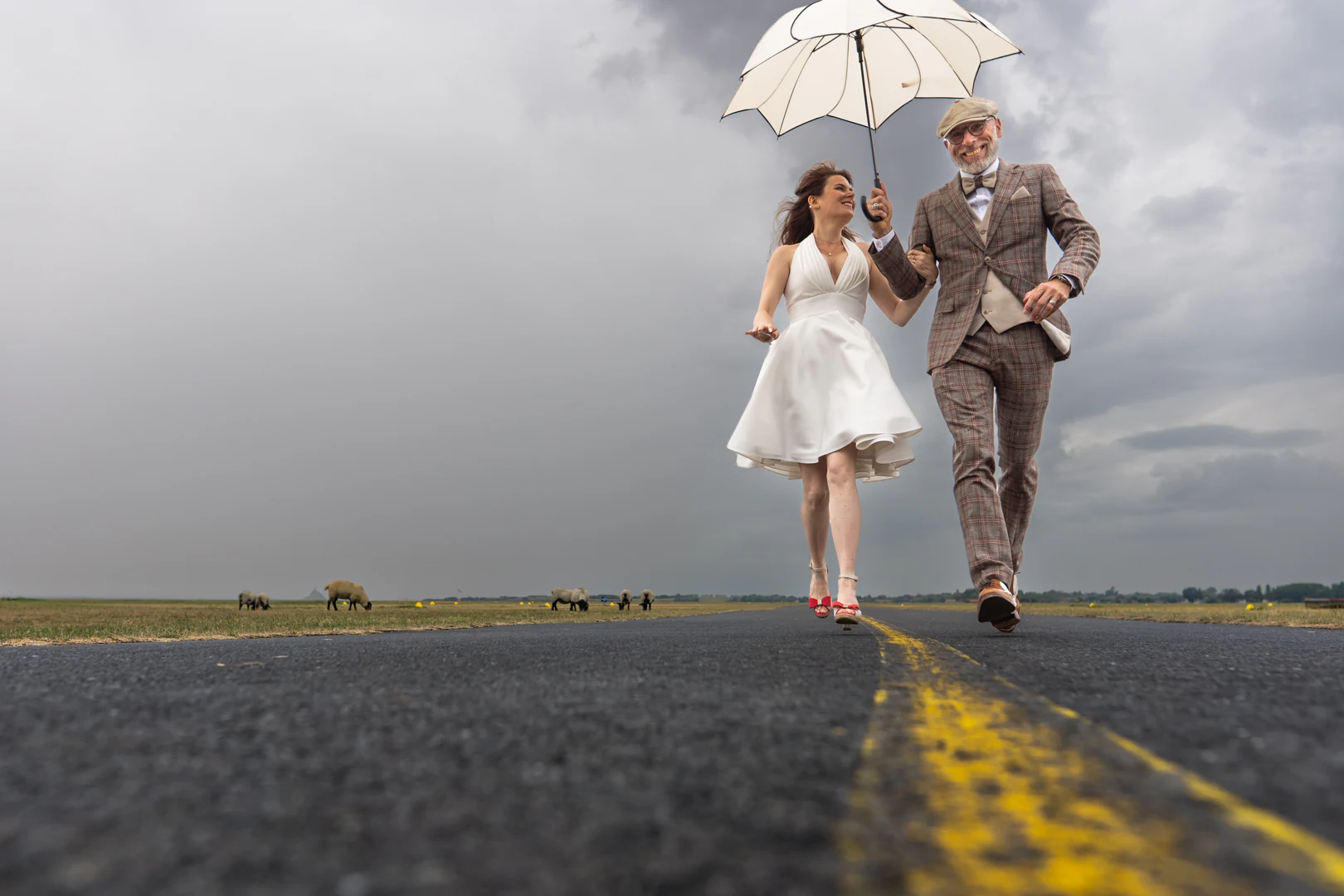
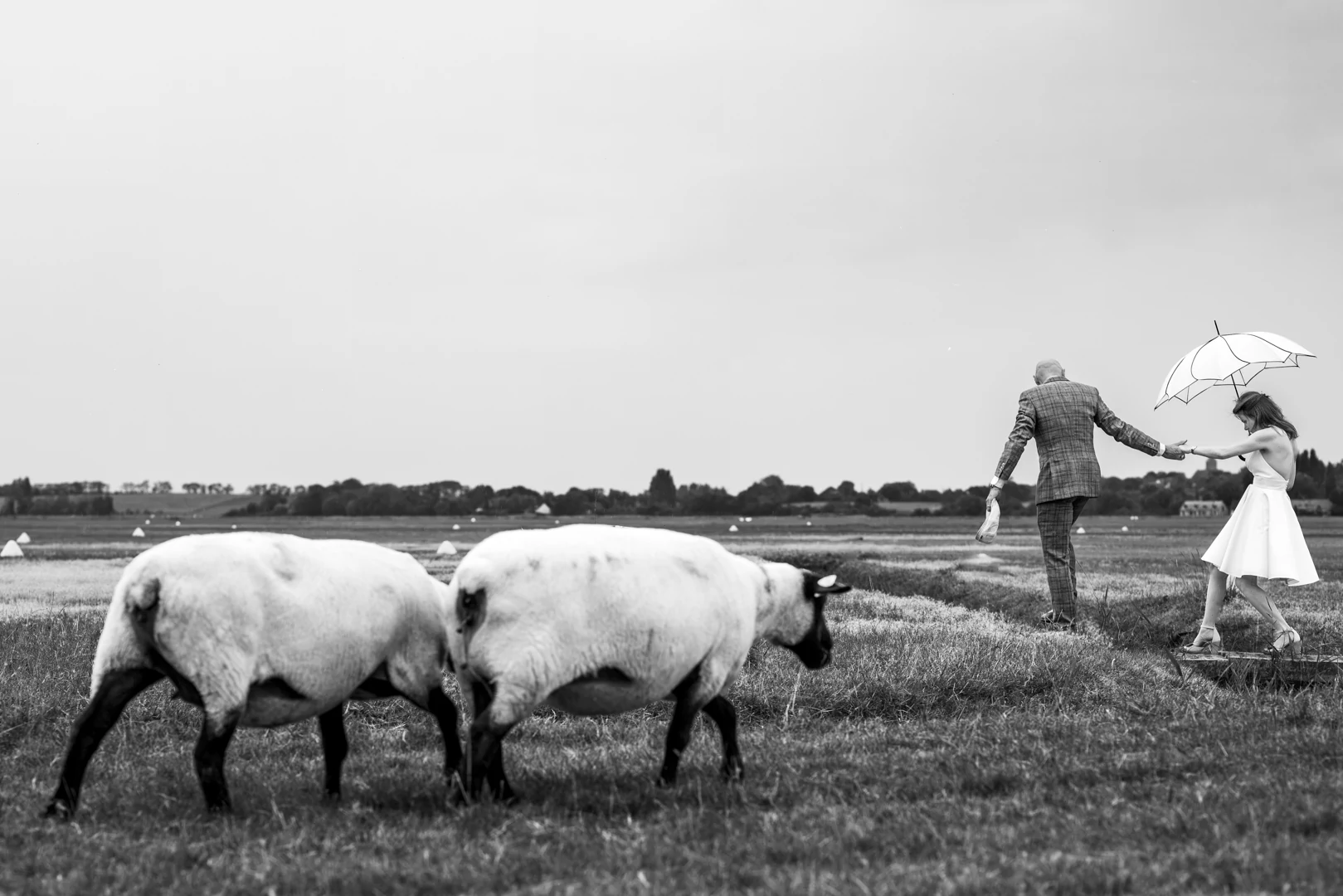
In practice that means a runway lined with salt-marsh sheep, a perfectly flat horizon, and the Mont visible in the distance when the weather allows. That day the sky was heavy, and the umbrella was not a prop.
Those sheep are not there by accident and they are not extras: they graze the salt marshes all year round, and they are what gives the local lamb its name. Walking out to the aircraft that day meant crossing ditches and stepping around puddles — in a dress and heels.
The biplane, open to the weather
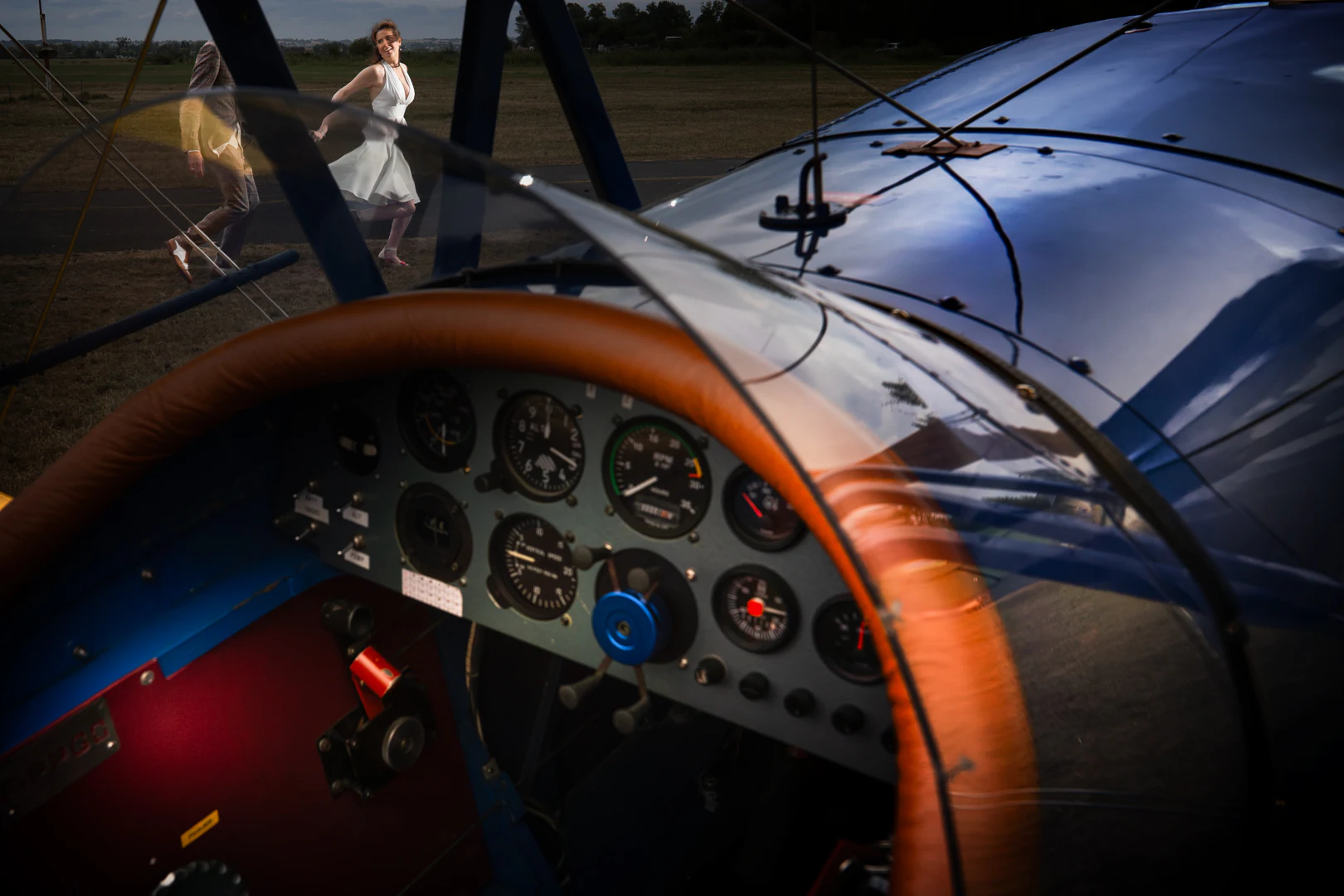
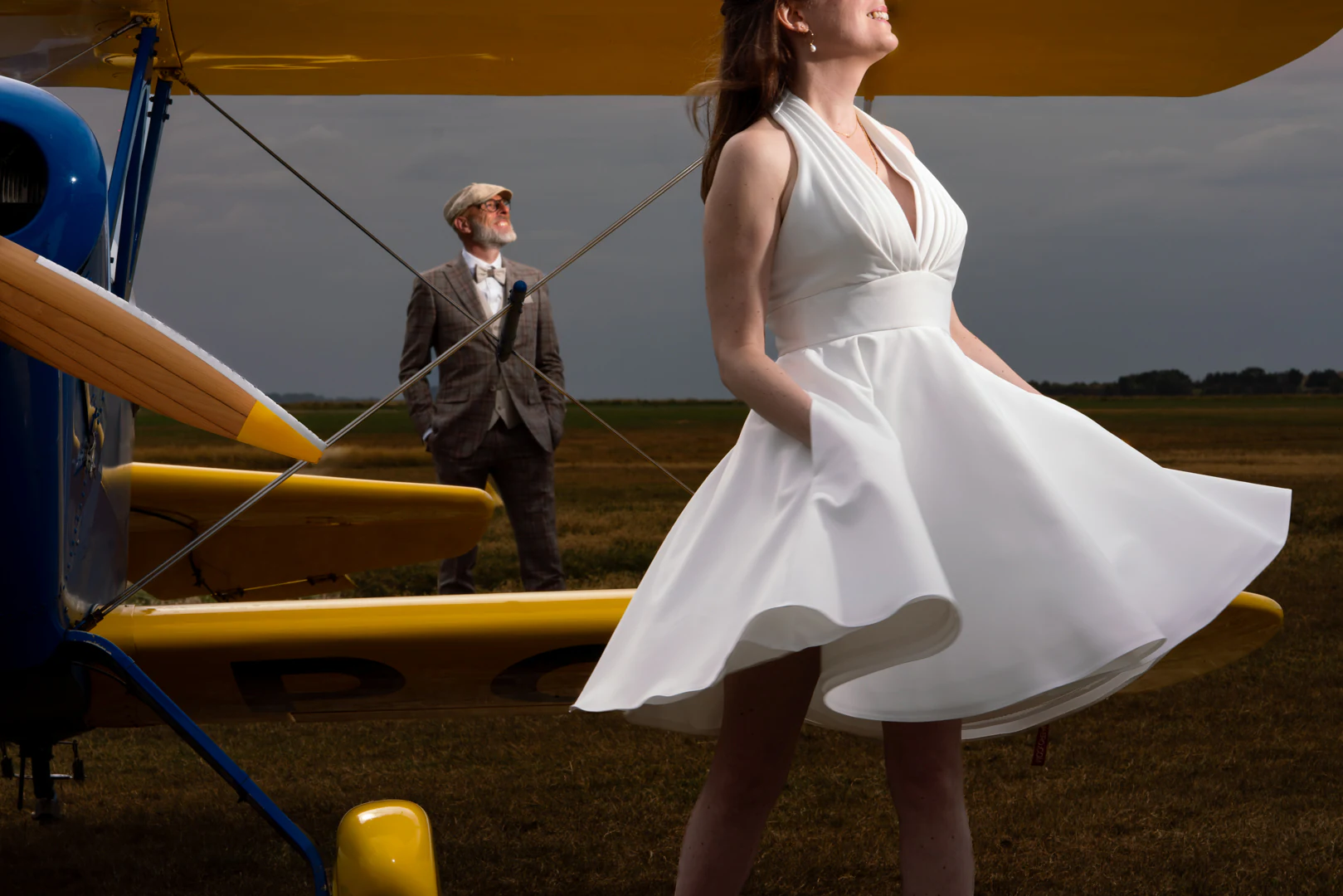
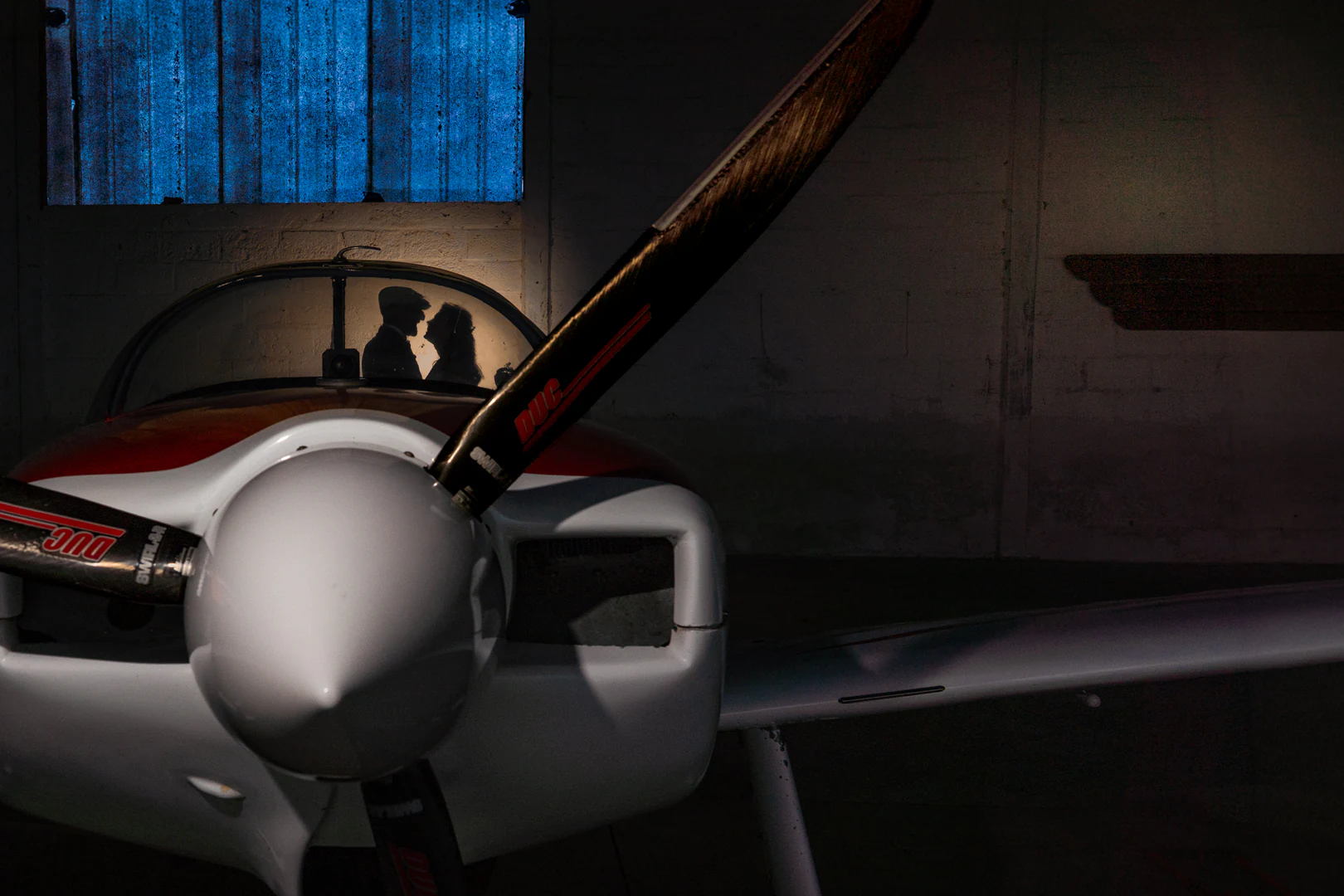
A yellow and blue biplane was waiting on the grass, its open cockpit catching the wind. Under the lower wing, Charlotte spun her dress while Laurent watched. The photograph that opens this article was made a few minutes later, from the pilot's seat: the instrument panel in the foreground, the two of them beyond the windscreen. That is his seat. That is where they had to be seen from.
We stayed on the ground. An after-wedding session does not need to take off to be about flying — it needs to happen in the exact place where flying happens.
Inside the hangars, where the aircraft sleep
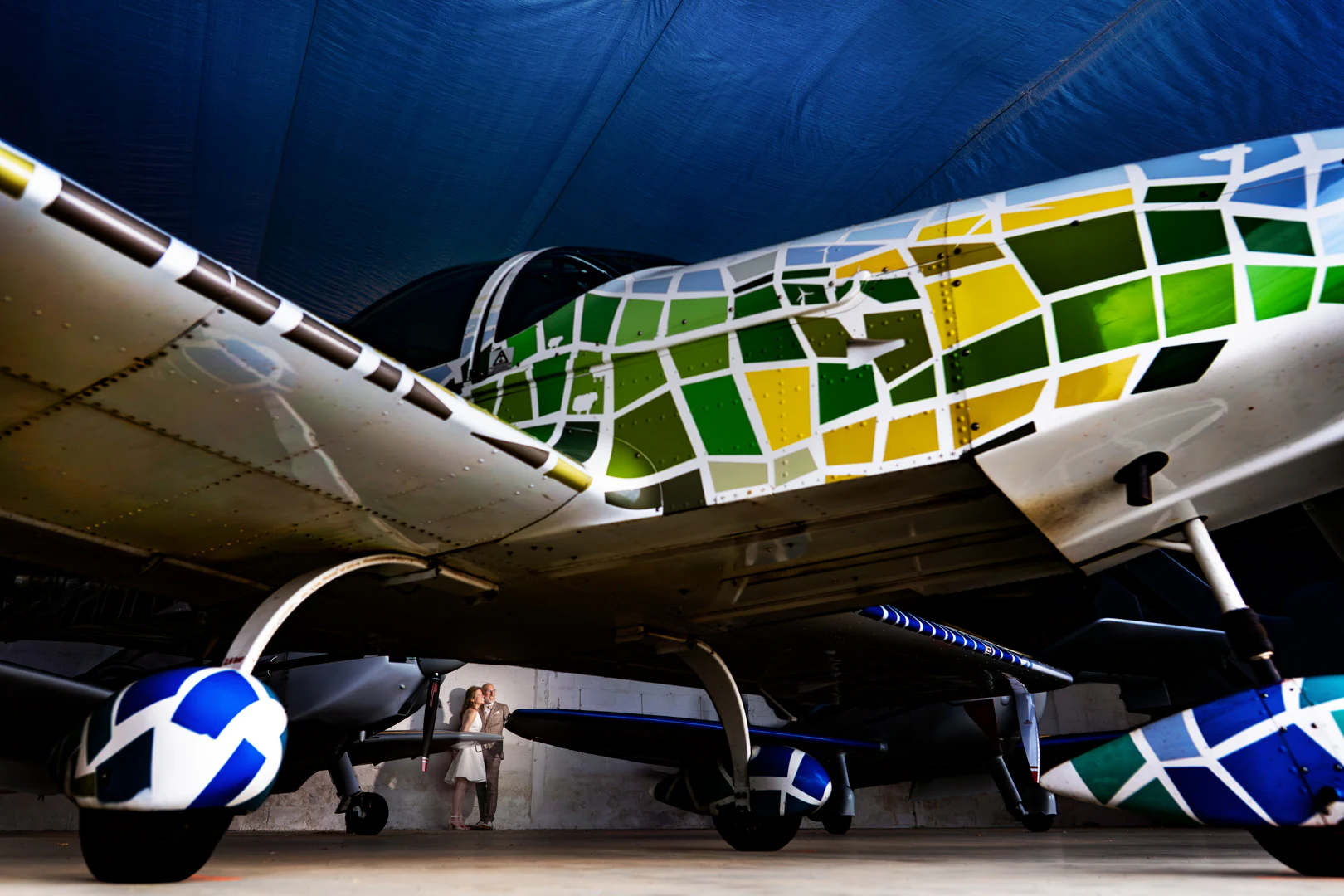
The rain eventually pushed us indoors, and that is often where a session turns. A flying-club hangar is a huge volume of concrete, glazed panels and wings parked side by side — with light coming in only through the openings. You work with contrast there, not with quantity.
In that frame they are tiny at the back of the hangar, under the wings. That was deliberate. A couple dwarfed by a machine says more about Laurent's world than a tight portrait ever could.
The green doors
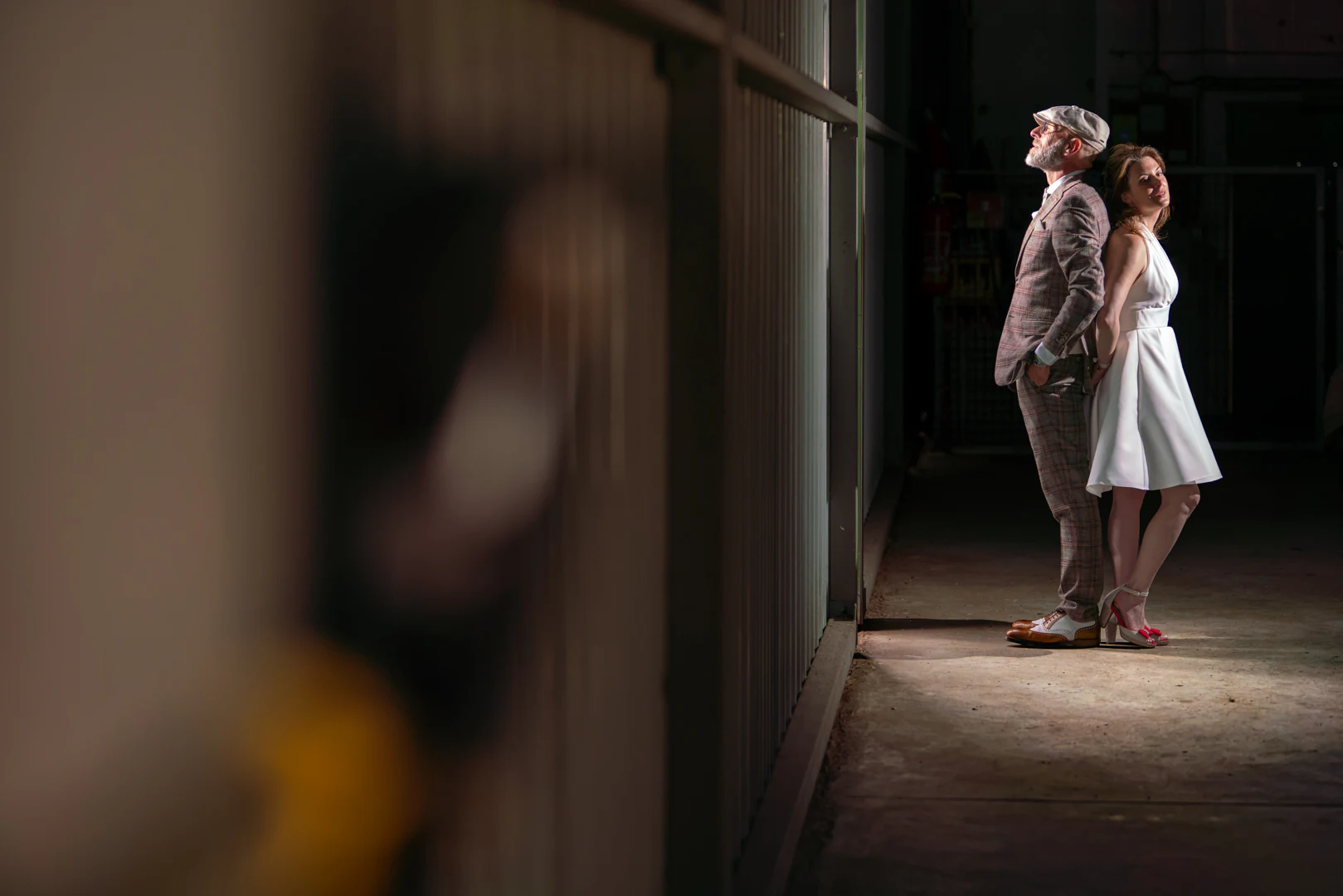
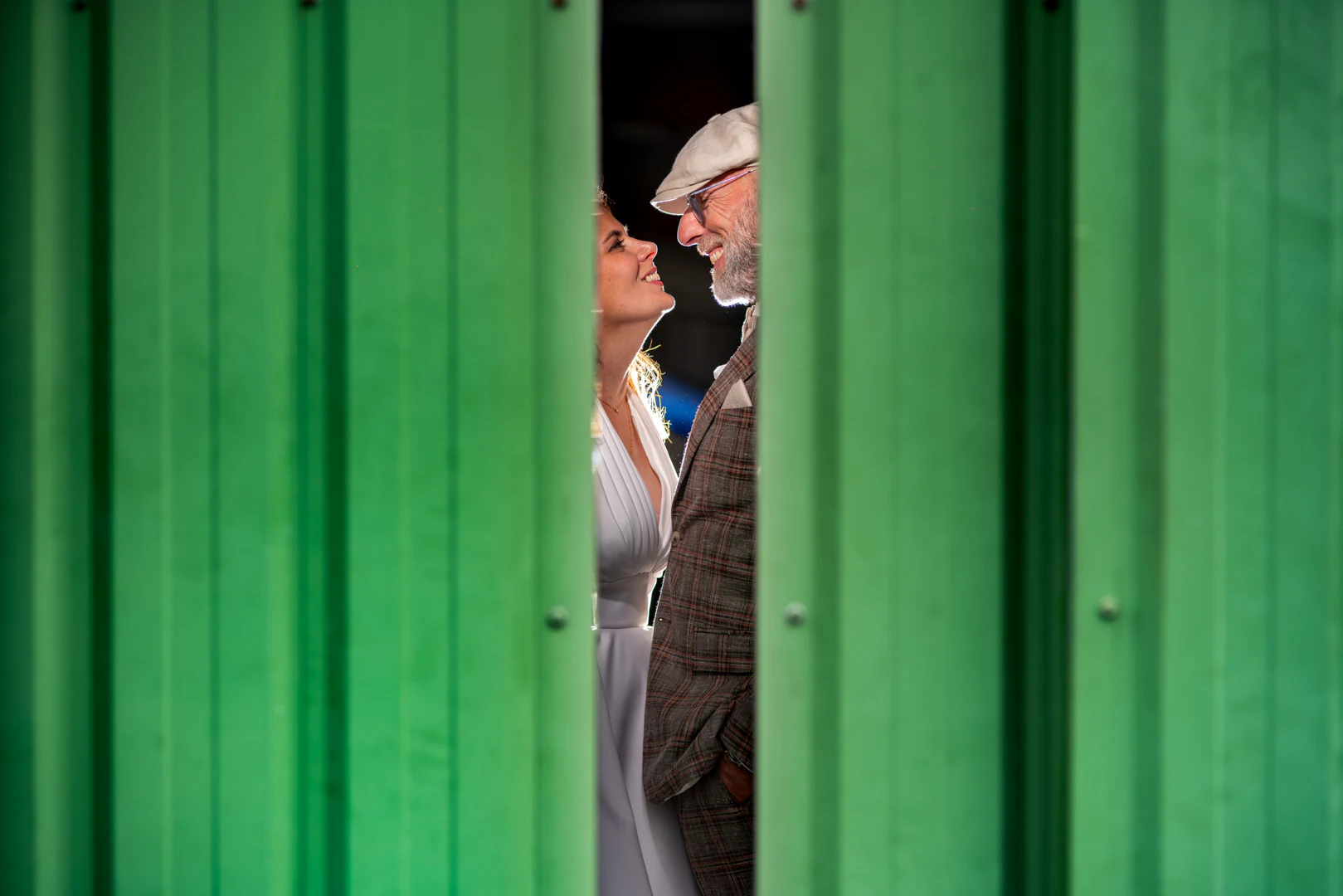
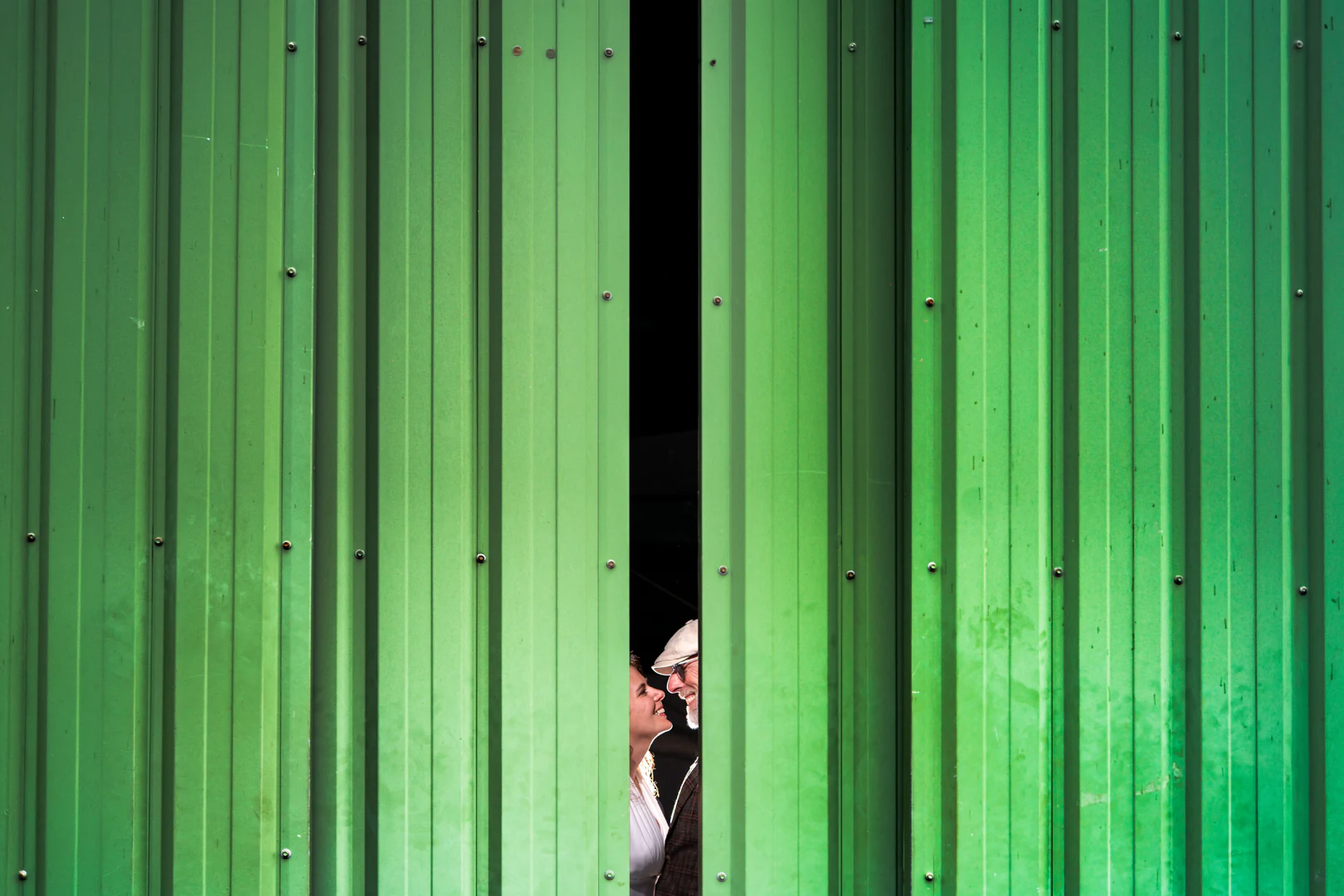
The hangars on the field close with tall sheets of green corrugated steel. Left ajar, they leave a gap a few centimetres wide. We used it as a frame: the whole wall, and the two of them in the slot.
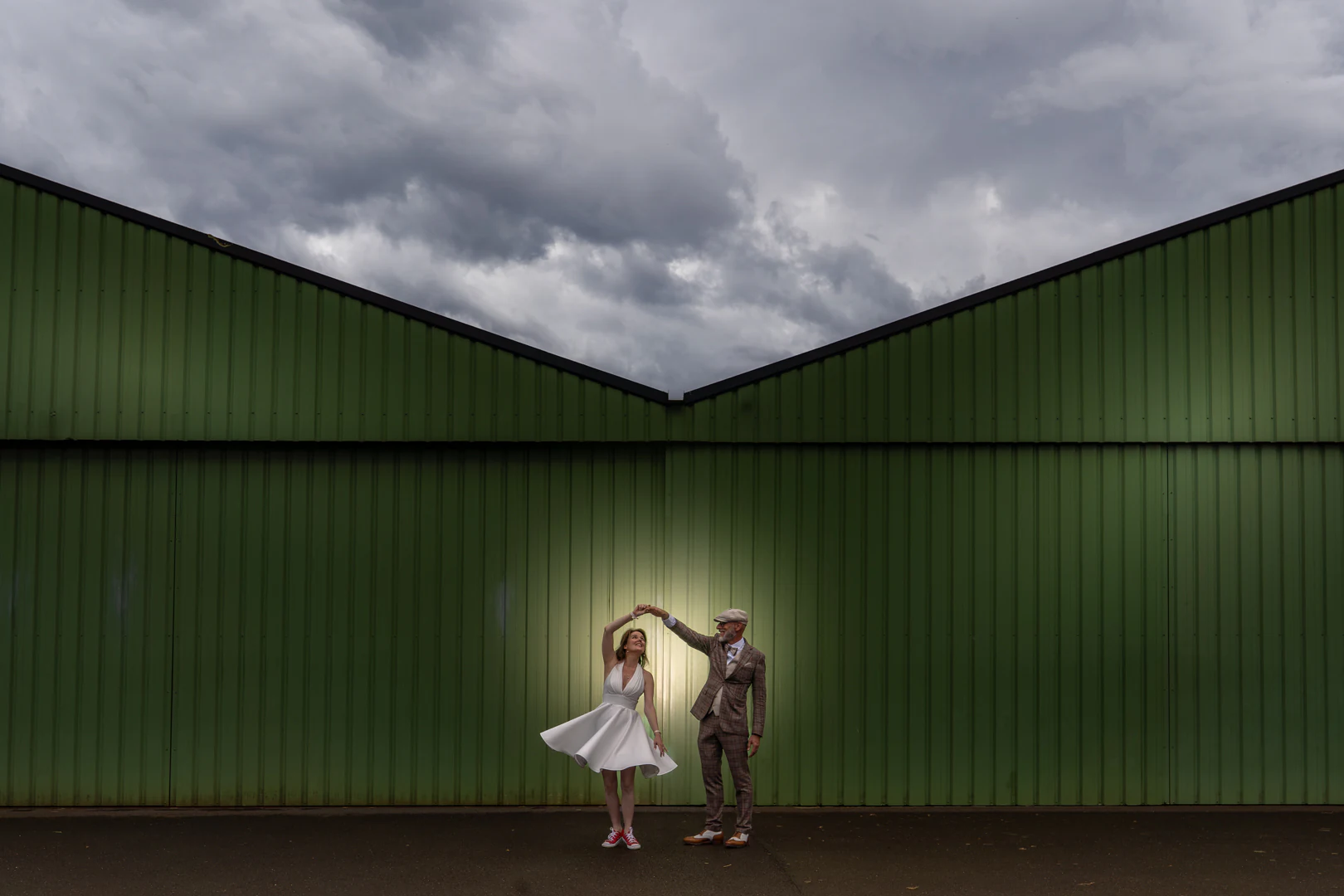
The last frame sums up what an after-wedding session is. The red heels from earlier have given way to red trainers, the sky is turning to storm, and they are dancing in front of a hangar anyway. Nobody is waiting for them. That is the whole point.
Why an after-wedding session is worth it
On the wedding day itself, the couple session lasts twenty minutes and is squeezed between two speeches. In an after-wedding session you choose the date, the hour and the place — and above all you take your time. You can go somewhere that means something to you rather than somewhere that simply photographs well.
Thank you to Charlotte and Laurent for putting the dress and the suit back on, walking through the mud, and dancing under a sky that meant it.